
Abstract
Recent progress in language-model-based agents has shifted part of the artificial-intelligence problem from isolated models toward architectures that preserve memory, context, tools, goals, and state across time. MemGPT, AIOS, temporal knowledge graphs, and recent Agent Operating System proposals illustrate a convergence toward persistent agents with explicit memory and control mechanisms. Yet recording that two events occurred at different times does not establish that a meaningful structure recurred across time. This paper presents XChronos OS as a temporal-semantic operating layer for persistent human-AI systems. In its technically conservative formulation, XChronos is not a replacement for a conventional kernel; it is a user-space runtime that represents meaningful events, detects intertemporal recurrences, records transitions, and exposes these structures to agents and applications. The proposal is centered on a falsifiable distinction between semantic similarity and meaningful recurrence. Chronons encode events; Hexacronons encode structured recurrences; Metacronons encode transitions; and Autocronons encode reorganization emerging from human-AI interaction. Proof-of-Recurrence (PoR) and the Hexacronon Score (HXS) are framed as empirical mechanisms rather than ontological guarantees. We position XChronos against AIOS, MemGPT, Zep/Graphiti, and OpenCog Hyperon, and specify hypotheses, baselines, ablations, frozen-holdout evaluation, and independent replication. The central question is intentionally narrow: can explicit temporal-semantic recurrence provide measurable information beyond semantic similarity, retrieval, and temporal history alone?
Keywords: XChronos; AI agents; long-term memory; semantic recurrence; temporal knowledge graphs; Proof-of-Recurrence; agent operating systems; hybrid cognition.
Resumo
A evolução recente de agentes baseados em modelos de linguagem deslocou parte do problema da inteligência artificial do modelo isolado para a arquitetura que mantém memória, contexto, ferramentas, objetivos e estado ao longo do tempo. Sistemas como MemGPT, AIOS, temporal knowledge graphs e propostas recentes de Agent Operating Systems indicam convergência em direção a agentes persistentes com mecanismos próprios de memória, escalonamento e controle. Entretanto, representar que um fato ocorreu em determinado momento não equivale a determinar que uma estrutura significativa reapareceu através do tempo. Este artigo apresenta o XChronos OS como uma proposta de camada operacional temporal-semântica para sistemas humano-IA persistentes. A arquitetura é tratada, em sua forma tecnicamente conservadora, como uma camada de espaço de usuário sobre um sistema operacional convencional, responsável por representar eventos significativos, detectar recorrências intertemporais, registrar transições de estado e disponibilizar essas estruturas a agentes e aplicações. O núcleo da proposta é a distinção entre similaridade semântica e recorrência significativa. Chronons representam eventos; Hexacronons, recorrências estruturadas; Metacronons, transições; e Autocronons, reorganizações produzidas na interação humano-IA. Proof-of-Recurrence (PoR) e Hexacronon Score (HXS) são reformulados aqui como mecanismos empíricos falsificáveis, não como garantias ontológicas. O artigo posiciona o XChronos em relação a AIOS, MemGPT, Zep/Graphiti e OpenCog Hyperon, define hipóteses testáveis, baselines obrigatórios, ablações e um protocolo confirmatório baseado em congelamento prévio, holdout e replicação independente. A tese examinada é deliberadamente estreita: uma arquitetura que trata recorrência temporal-semântica como primitiva explícita consegue representar e utilizar padrões longitudinais de forma mensuravelmente distinta de similaridade, recuperação e simples histórico temporal?
Palavras-chave: XChronos; agentes de IA; memória de longo prazo; recorrência semântica; temporal knowledge graphs; Proof-of-Recurrence; sistemas operacionais para agentes; cognição híbrida.
1. Introduction
Traditional operating systems were designed to manage processes, threads, memory, files, devices, permissions, and other computational resources. The recent expansion of artificial-intelligence agents has introduced a class of entities with properties that differ from conventional applications: agents may remain active for long periods, maintain goals, invoke tools dynamically, modify their behavior based on experience, and accumulate contextual states that span multiple sessions.
This transformation has already produced explicit proposals for operating-system-inspired infrastructure. AIOS separates agent-specific services – scheduling, context, memory, storage, and access control – into an agent kernel and reports efficiency gains in concurrent execution (Mei et al., 2024). MemGPT introduces hierarchical memory management inspired by virtual memory to extend the effective context of persistent agents (Packer et al., 2023). More recently, Sharma and Shah (2026) formalize Agent Operating Systems as an agentic control layer integrated with existing operating systems, with dedicated responsibilities for scheduling, memory, security, observability, and governance.
In parallel, memory architectures have begun to model temporality explicitly. Zep/Graphiti uses a temporal knowledge graph capable of preserving historical relationships and integrating dynamic information from conversations and structured data (Rasmussen et al., 2025). LongMemEval showed that temporal reasoning, knowledge updating, multi-session retrieval, and abstention remain challenging for assistants with long-term memory; LongMemEval-V2 extended this concern to experiential memory for agents operating in complex environments (Wu et al., 2024; Wu et al., 2026).
The problem motivating this paper is not simply remembering the past. It is deciding when events separated in time are manifestations of the same meaningful structure – and when similarity is misleading.
XChronos enters this space with a specific proposal: to treat temporal-semantic recurrence as an explicit computational primitive. Earlier project literature described Chronons, Hexacronons, Metacronons, Autocronons, Proof-of-Recurrence (PoR), the Hexacronon Score (HXS), XSL, and a semantic operating-system architecture (Silva, 2025a; Silva, 2025b; Silva, 2026a). The purpose of this paper is to reformulate that proposal in terms that permit comparison, refutation, and incremental implementation.
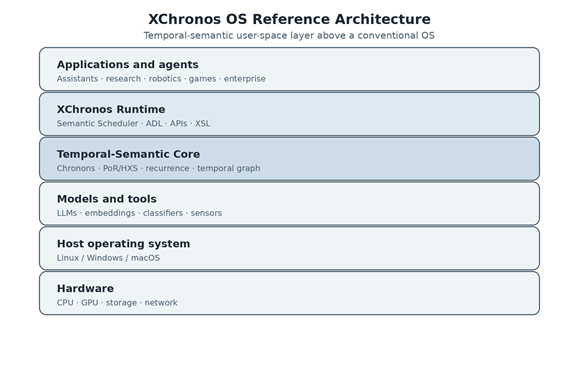
Figure 1. Reference architecture: XChronos as a temporal-semantic layer above a conventional operating system.
2. Contribution and epistemic scope
The candidate contribution of XChronos should not be framed as a broad claim that current systems lack memory, temporality, or cognition. All of these topics have extensive literatures and relevant implementations. The technically defensible claim must be narrower: explicitly representing recurrences across a trajectory may provide operational information that is not equivalent to semantic similarity, memory retrieval, or temporal storage alone.
To preserve this distinction, this paper separates three levels of claim. The ontological level asks whether Chronons and Hexacronons correspond to fundamental properties of experience or subjective time. The computational level asks whether these entities can be represented, manipulated, and evaluated by algorithms. The instrumental level asks whether using them improves measurable tasks. The experimental program defended here concentrates on the latter two levels.
No computational result will be treated automatically as evidence of consciousness, artificial phenomenology, or metaphysical validity. A system may preserve a trajectory, detect patterns, and reorganize priorities without subjective experience following from those capacities. This restriction does not weaken the program; it makes the hypothesis technically evaluable.
3. Related work and boundary of differentiation
3.1 Agent Operating Systems
AIOS proposes an agent kernel that centralizes scheduling, context management, memory, storage, tools, and access control (Mei et al., 2024). AOS broadens the discussion by defining an agentic control layer that may operate in user space or progressively integrate with Linux and Windows primitives (Sharma & Shah, 2026). XChronos shares the need for persistent memory, scheduling, and observability, but proposes adding signals derived from the temporal-semantic trajectory to operational decision-making.
3.2 Persistent memory and virtual context
MemGPT showed that virtual-memory principles can be adapted to manage LLM context and support persistent conversations beyond the model context window (Packer et al., 2023). The functional boundary is important: retrieving a previous episode is not equivalent to recognizing a recurrent structure spanning several episodes. XChronos must empirically demonstrate that the second operation adds useful information.
3.3 Temporal knowledge graphs
Zep/Graphiti is perhaps the closest technical neighbor to the future XChronos memory layer. Its graph preserves facts and relationships together with temporal and historical information, enabling dynamic synthesis of data across conversations and enterprise contexts (Rasmussen et al., 2025). The distinction proposed by XChronos is between temporal history and recurrent structure within that history: a graph may record change without necessarily certifying that temporally separated occurrences instantiate the same semantic organization.
3.4 OpenCog Hyperon
OpenCog Hyperon is an important reference because it combines a metagraph-based cognitive architecture (Atomspace) with its own language, MeTTa, for representing and transforming cognitive processes. This precedent prevents cognitive graphs or semantic languages from being treated as XChronos novelties. Any possible novelty must reside in an operational and empirically defensible specification of temporal-semantic recurrence, together with its integration into memory, scheduling, and agents (OpenCog, 2026).
| System | Central unit | Explicit time | Persistent memory | Scheduling | Distinctive hypothesis relative to XChronos |
| MemGPT | hierarchical context/memory | partial | yes | control flow | context management, not certified recurrence |
| AIOS | agent/resource | partial | yes | yes | agent and resource kernel |
| Zep/Graphiti | temporal entity/relation | yes | yes | not central | temporal factual history |
| OpenCog Hyperon | Atom/metagraph | partial | yes | cognitive | integration of cognitive algorithms |
| XChronos (proposed) | event/recurrence/transition | yes | yes | semantic, proposed | temporal-semantic recurrence as an operational signal |
Table 1. Conceptual positioning. The table does not imply superiority; it identifies different units of abstraction and hypotheses.
4. Minimal formalization
4.1 Chronon as an operational unit
For computational purposes, a Chronon may be defined as a temporally indexed event with content and context:
Cᵢ = (xᵢ, tᵢ, mᵢ) (1)
where xᵢ represents the content or state associated with the event, tᵢ its temporal position, and mᵢ contextual metadata. The definition is intentionally multimodal: a Chronon may originate from text, an agent decision, a software event, a sensor observation, or a human-machine interaction.
A representation function φ may map the content into a vector space and provide an initial similarity Sᵢⱼ:
φ(Cᵢ) ∈ Rᵈ; Sᵢⱼ = sim(φ(Cᵢ), φ(Cⱼ)) (2)
The XChronos hypothesis begins precisely where this equation ceases to be sufficient: a high Sᵢⱼ should not be a sufficient condition for declaring recurrence.
4.2 Similarity versus recurrence
Consider two events: “continue the project” and “abandon the project.” They share a domain, entity, linguistic structure, and several semantic components, yet diverge in their intent vector. In an XChronos system, cases of this kind should be treated as adversarial tests because they permit high similarity without preservation of the relevant relation.
The experimental program uses categories such as SAME, REVERSED, OFFTARGET, and CHANGED-INTENT to separate equivalence, inversion, target deviation, and intent change. These categories are not presented as a universal ontology of semantics; they function as test regimes for the central question: did the relevant structure remain invariant?
4.3 Hexacronon, HXS, and PoR
A Hexacronon may be treated operationally as a set of Chronons satisfying sufficient recurrence criteria:
H = {Cᵢ₁, Cᵢ₂, …, Cᵢₙ} (3)
The published formulation of the Hexacronon Score uses recurrence density D_H, coherence K_H, and temporal reach R_H:
HXS = D_H × K_H × R_H, HXS ∈ [0,1] (4)
Multiplication is conceptually useful because it requires the components to coexist, but mathematical elegance does not demonstrate utility. The metric must be validated against external properties: stability, discrimination, calibration, predictive capacity, or downstream gain.
Proof-of-Recurrence should be interpreted in this paper as an empirical decision protocol rather than a mathematical “proof”:
PoR(H) ∈ {PASS, ABSTAIN, FAIL} (5)
PASS corresponds to a preregistered set of criteria; ABSTAIN represents insufficient evidence; FAIL indicates that recurrence requirements were not satisfied. Explicit abstention reduces pressure to transform ambiguous cases into false positives.
5. XChronos as an operating layer
The most conservative interpretation of the term “OS” does not require replacing the Linux, Windows, or macOS kernel. The first defensible implementation is a user-space layer that manages a different class of state: events, recurrences, trajectories, transitions, context, and semantic priority. The host operating system remains responsible for processes, memory pages, drivers, filesystems, networking, and low-level isolation.
This decision reduces risk and increases testability. XChronos can initially be distributed as a runtime or daemon, with persistent storage, API, CLI, and integration with multiple models. If the layer demonstrates utility, a distribution or deeper integration can be discussed later.
5.1 Minimum components
| Component | Minimum responsibility | Maturity criterion |
| Ingestion Layer | receive events and provenance | versioned and auditable inputs |
| Chrononizer | normalize events into Chronons | stable schema + validation |
| Semantic Representation | produce features/representations | reproducibility + versioning |
| Recurrence Engine | propose candidate recurrences | controllable recall |
| PoR/HXS Validator | certify/reject/abstain | calibration + frozen gates |
| Temporal Semantic Graph | persist events, relations, and history | explicit provenance and temporality |
| Semantic Scheduler | use XChronos signals for prioritization | measured downstream gain |
| XSL Interface | serialize entities and relations | demonstrated interoperability |
Table 2. Minimum implementable architecture without replacing the host kernel.
5.2 Independence from the base model
A desirable property is separation between XChronos state and the AI model assisting its interpretation. If the entire trajectory disappears when the LLM is replaced, the architecture becomes a model wrapper. The goal is for memory, events, relationships, and PoR results to be persisted in model-independent structures, allowing models to be replaced and their impact compared.
6. Falsifiable hypotheses
The principal claims must admit negative results. Table 3 translates the architecture into a set of testable hypotheses and specifies outcomes that would reduce its scope.
| Hypothesis | Prediction | Result that weakens it |
| H1 – Discrimination | PoR separates recurrence from misleading high similarity | near-chance performance or collapse on adversarial cases |
| H2 – Incremental value | PoR/HXS adds signal beyond the best baseline | no gain or complementarity over a simple baseline |
| H3 – Generalization | performance remains high on a frozen holdout | severe drop outside development data |
| H4 – Temporality | temporal information improves temporal tasks | removing time does not change the result |
| H5 – HXS | HXS correlates with external utility | HXS is redundant with features already used |
| H6 – Portability | XChronos state survives base-model replacement | result depends on a single model/checkpoint |
Table 3. Hypotheses and criteria for reducing the thesis.
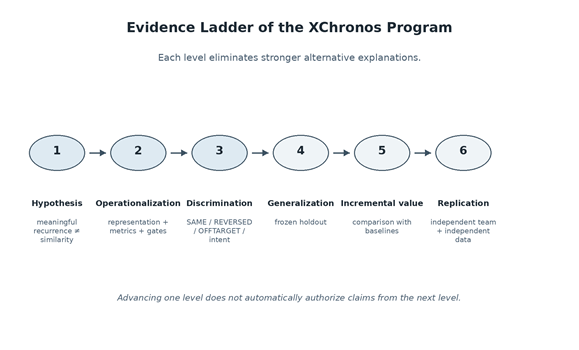
Figure 2. Evidence ladder: from a formal hypothesis to independent replication.
7. Confirmatory experimental program
7.1 Separate development from confirmation
Successive iterations over the same set of examples can produce experimental overfitting even when no deliberate manipulation occurs. Therefore, before a confirmatory test, the following must be frozen: code, model version, tokenizer, representation, thresholds, seeds, decision rules, development datasets, and PASS criterion.
The confirmatory question is not “can we tune it until it works?” but “does a rule defined before observing the new set continue to work?”
The confirmatory holdout must not be used for subsequent tuning. If the gate fails, the result remains FAIL; a new hypothesis may be developed, but it requires a new confirmatory set. This discipline prevents the test set itself from gradually becoming a training set.
7.2 Required baselines
The minimum benchmark must include simple alternative explanations. Under the same data splits and metrics, the architecture should be compared with: (i) cosine similarity or an embedding threshold; (ii) nearest-neighbor retrieval; (iii) a conventional supervised classifier; and (iv) a temporal representation or temporal knowledge graph when the task involves history. Stronger baselines should be added as appropriate to the domain.
Beating earlier versions of XChronos itself is not sufficient. The scientifically relevant question is whether the recurrence abstraction offers value beyond available techniques.
7.3 Ablations
If the complete system outperforms baselines, it is still necessary to identify which components cause the gain. A minimal decomposition may represent the system as semantics S, structure K, temporality T, and density/recurrence D:
X = S + K + T + D (6)
Versions X-S, X-K, X-T, and X-D should be compared. If removing temporality does not reduce performance on temporal tasks, the temporal contribution is in doubt. If removing HXS does not change decisions or calibration, HXS may be dispensable. Ablations are essential for distinguishing architecture from conceptual ornamentation.
7.4 Metrics
Accuracy alone is insufficient for imbalanced datasets and does not measure calibration. Depending on benchmark design, recommended measures include macro-F1, precision/recall by regime, AUROC when applicable, calibration error, abstention rate, false-positive rate on adversarial cases, and bootstrap confidence intervals. Multiple seeds should be used whenever the pipeline contains relevant randomness.
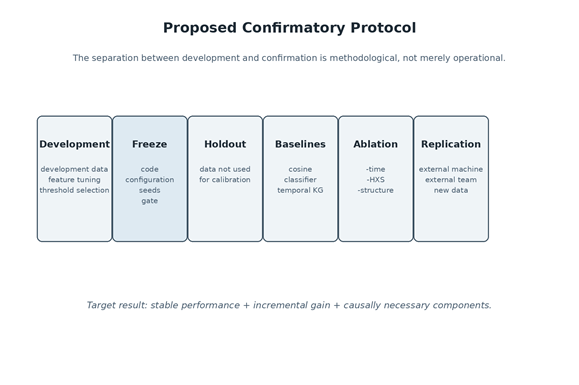
Figure 3. Proposed confirmatory protocol separating optimization, generalization, comparison, and replication.
8. Current implementation status: internal evidence and its limits
The XChronos implementation program has already moved beyond the purely conceptual stage: recurrence has been operationalized in software, robustness regimes and negative cases have been introduced, and the P2 layer has begun testing adversarial semantic discrimination. However, current results are internal, depend on the development environment, and should not yet be interpreted as independent validation.
In the most recent audited internal checkpoint preceding the next confirmatory test, the implementation reached 94.44% overall and macro accuracy, with 91.67% on SAME, 91.67% on REVERSED, 100% on OFFTARGET, and 83.33% on CHANGED-INTENT. The checkpoint remained formally failed because the CHANGED-INTENT regime remained below the defined gate and frozen generalization had not yet been established.
| Internal metric | Result | Permitted interpretation |
| Overall accuracy | 94.44% | strong internal signal; does not prove generalization |
| Macro | 94.44% | consistent aggregate performance on the evaluated set |
| SAME | 91.67% | good internal separation |
| REVERSED | 91.67% | internal capacity to recognize inversion |
| OFFTARGET | 100% | strong rejection on the evaluated set |
| CHANGED-INTENT | 83.33% | fragile regime; prevents closing the gate |
Table 4. Preliminary internal results. Not peer reviewed, not externally replicated, and not presented as a confirmatory result.
The rigorous interpretation is therefore asymmetric: the results reduce the plausibility of the hypothesis that the mechanism is incapable of any semantic discrimination, but they do not yet eliminate overfitting, dataset dependence, lexical shortcuts, or equivalence to conventional classifiers. The next evidence jump is a frozen holdout; the following one is direct comparison against baselines.
9. Why recurrence cannot be reduced to similarity
Similarity is typically a local relation between representations. Recurrence, as proposed by XChronos, is a property of a trajectory: it requires at least two occurrences, temporal distance, preservation of some structure, and relevance criteria. Temporality is not merely metadata; it participates in the hypothesis.
This difference also implies cases of low lexical similarity with possible structural equivalence. Two decisions expressed with different vocabulary may realize the same operational pattern; conversely, two nearly identical sentences may have opposite intentions. A useful benchmark must deliberately decouple similarity and recurrence, creating quadrants of high/low similarity by true/false recurrence.
| Quadrant | Similarity | Recurrence | Example test function |
| Q1 | high | true | easy positive case |
| Q2 | high | false | inversion, changed intent, false friend |
| Q3 | low | true | distant paraphrase / structural equivalence |
| Q4 | low | false | clear negative |
Table 5. Minimum design for decoupling similarity from recurrence.
10. XSL and interoperability
The XChronos Semantic Language (XSL) was proposed in the project corpus as a declarative language for representing Chronons, Hexacronons, Metacronons, and Autocronons (Silva, 2026a). Its existence, however, is technically justified only if it offers advantages over conventional formats.
The appropriate criterion is not “the syntax is original,” but whether XSL provides useful formal semantics, validation, portability, and tooling. A comparative test could serialize the same graph in XSL, JSON Schema, and RDF/OWL, measuring information loss, ease of validation, and interoperability cost. If an existing format fully represents the entities without loss, XSL should be simplified or repositioned as a convenience DSL rather than an ontological requirement.
11. Metacronons and Autocronons: later hypotheses
Metacronons and Autocronons belong to a later layer of the program and require greater caution. A Metacronon can be operationalized as a regime change along a trajectory and compared with change-point detection, state-space models, or temporal clustering. To justify the term, the implementation must demonstrate that the XChronos representation identifies useful transitions beyond conventional techniques.
Autocronons are proposed as relevant reorganizations produced through human-AI interaction. To avoid unrestricted retrospective interpretation, their detector must depend on observables defined before analysis: a recorded change of belief or plan, a persistent policy change, a new graph relation, or another measurable criterion. Without an external indicator of change, “Autocronon” risks becoming a post hoc label.
12. Semantic Scheduler as a systems hypothesis
The existence of a recurrence engine does not automatically imply a better scheduler. The Semantic Scheduler must be treated as a separate systems hypothesis. The idea is to combine conventional signals – availability, cost, deadline, dependencies – with temporal signals derived from XChronos, such as recurrence, novelty, goal continuity, or PoR confidence.
Evaluation must be downstream. Rather than asking whether HXS “looks” like a good priority, one should measure task success, latency, cost, unnecessary interruptions, and decision quality compared with policies that do not use the XChronos signal. A scheduler is justified only if it produces operational gain.
13. Provenance, privacy, and longitudinal risk
A longitudinal architecture can produce a representation of the user that is more revealing than a conventional history. Inferred recurrences may expose habits, changes of intent, relationships, vulnerabilities, behavioral patterns, and long-term goals. Provenance, permissions, auditability, encryption, export, and deletion must therefore be treated as architectural properties rather than late additions.
Proposed principle: no recurrence without provenance. Every temporal-semantic inference should be able to point to the events, model versions, and rules that contributed to its formation.
This principle also reduces an epistemic risk: model-generated inferences should not be silently transformed into “biographical truths.” The system must preserve the distinction among observation, inference, confidence, and user contestation.
14. Reproducibility and evidence package
A PASS on a single machine is not replication. Machine-learning libraries may differ across versions, platforms, CPUs, and GPUs; moreover, seeds and nondeterministic algorithms can alter metrics near narrow thresholds. The confirmatory package must record versions, hashes, seeds, configuration, raw outputs, and exact commands.
A minimum scientific release would include an environment lock, Dockerfile or equivalent, datasets with hashes, frozen configuration, reproduction script, expected outputs, seeds, metrics report, and license. The objective is to allow a person not involved in development to execute the protocol without tacit knowledge.
External replication has two distinct levels. At the first, another team runs the same artifact and obtains compatible results. At the second, it creates independent data or a compatible implementation and observes the same phenomenon. The second level constitutes substantially stronger evidence.
15. Proposed benchmark: RecurrenceEval
The development of XChronos suggests the usefulness of a benchmark independent of the implementation itself. RecurrenceEval, a provisional name, would evaluate whether systems can distinguish temporal-semantic recurrence from misleading similarity. The dataset should contain trajectories, not only isolated pairs, and include explicit temporal provenance.
Case families should include: preservation of intent under paraphrase; relation inversion; intent change with high overlap; structural recurrence with low lexical overlap; thematic false positives; recurrence after long intervals; interference from intermediate events; later contradiction; and ambiguous cases that justify abstention.
An independent benchmark is valuable even if XChronos does not win. It separates the scientific question – how to measure longitudinal recurrence – from the specific architecture proposed to answer it.
16. Engineering and validation program
| Milestone | Evidence product | Exit criterion |
| P2 – Semantic generalization | frozen holdout + metrics by regime | preregistered gate satisfied |
| P3 – Full PoR | engine + baselines + ablations | gain or complementarity demonstrated |
| P4 – Executable XSL | parser/validator/IR | measurable interoperability |
| P5 – Semantic Runtime | memory + graph + initial scheduler | persistence and downstream utility |
| P7 – Linux Runtime | daemon/API/CLI/installer | reproduction on a clean machine |
| P8 – XChronos OS 1.0 | integrated release + documentation | stability, security, and initial external adoption |
Table 6. Evidence-oriented roadmap. Numbering preserves the project’s internal nomenclature; neuromorphic hardware remains optional.
Keeping neuromorphic computing as an optional branch is methodologically useful. If the temporal-semantic core can be tested on conventional hardware, requiring specialized hardware would add cost without demonstrated causal necessity. A future neuromorphic backend should be compared with a conventional baseline on latency, energy, throughput, and quality rather than presumed superior by conceptual affinity.
17. Limitations
This paper has important limitations. First, XChronos remains a program under development and has no published external validation of the PoR/HXS core. Second, the internal results reported here are preliminary and may reflect idiosyncrasies of the dataset, base model, or development strategy. Third, the project’s ontological terminology is broader than the computational evidence currently available; this paper deliberately narrows the scope to preserve testability.
Fourth, the mere fact that an architecture can be operationalized does not demonstrate that its abstractions are the best ones. Conventional methods may achieve equal or superior performance. Fifth, the use of temporal structures on personal data introduces risks of privacy, over-interpretation, and lock-in that must be addressed independently of technical performance.
18. Discussion: what would make XChronos scientifically relevant?
The most relevant result would not be demonstrating that XChronos stores memory or executes agents; those capabilities already exist in competing architectures. The distinctive contribution must be narrower: demonstrating that temporal-semantic recurrence is a useful, measurable computational variable that is operationally distinct from similarity, retrieval, and simple temporal history.
If this distinction is established, Chronons and Hexacronons cease to operate only as philosophical vocabulary and begin to correspond to tested computational abstractions. The next step is to show utility: the new information improves longitudinal memory, agent prioritization, change detection, prediction, or another task. Only after those results is it appropriate to discuss XChronos as a new category of cognitive operating layer.
The value of the program lies precisely in allowing the thesis to be reduced. If PoR adds nothing beyond embeddings, the component can be abandoned or reformulated. If temporality does not matter, the temporal narrative should be reduced. If HXS is redundant, the metric should be removed. An architecture that survives this process becomes stronger precisely because it retains only components that demonstrate function.
19. Conclusion
Contemporary artificial intelligence is moving from episodic interactions toward persistent systems. Agents maintain memory, use tools, span sessions, accumulate experience, and increasingly require dedicated layers for scheduling, context, security, and observability. XChronos proposes adding one further primitive to this space: temporal-semantic recurrence.
Its technically relevant thesis can be reduced to two propositions. First: meaningful recurrence is not equivalent to mere semantic similarity. Second: explicitly modeling this difference produces useful information for persistent systems. The first proposition requires frozen and adversarial holdouts; the second requires baselines, ablations, and downstream tasks.
meaningful recurrence ≠ mere similarity (7)
explicitly modeling recurrence → measurable utility (8)
If these propositions fail, the technological scope of XChronos should be reduced. If they survive generalization, comparison, and external replication, the result will be substantial: a temporal-semantic layer capable of maintaining trajectories and detecting longitudinal patterns as explicit computational objects, independent of a particular language model.
The strongest claim XChronos needs to earn is not “we are a new operating system.” It is: “useful temporal-semantic information disappears when memory is treated only as retrieval or similarity.”
References
MEI, K.; ZHU, X.; XU, W.; HUA, W.; JIN, M.; LI, Z.; XU, S.; YE, R.; GE, Y.; ZHANG, Y. AIOS: LLM Agent Operating System. arXiv:2403.16971, 2024. https://arxiv.org/abs/2403.16971
OPENCOG. OpenCog Hyperon: Atomspace Metagraph and MeTTa Programming Language. 2026. https://hyperon.opencog.org/
PACKER, C.; WOODERS, S.; LIN, K.; FANG, V.; PATIL, S. G.; STOICA, I.; GONZALEZ, J. E. MemGPT: Towards LLMs as Operating Systems. arXiv:2310.08560, 2023. https://arxiv.org/abs/2310.08560
RASMUSSEN, P.; PALIYCHUK, P.; BEAUVAIS, T.; RYAN, J.; CHALEF, D. Zep: A Temporal Knowledge Graph Architecture for Agent Memory. arXiv:2501.13956, 2025. https://arxiv.org/abs/2501.13956
SHARMA, A.; SHAH, D. Agent Operating Systems (AOS): Integrating Agentic Control Planes into, and Beyond, Traditional Operating Systems. arXiv:2606.01508, 2026. https://arxiv.org/abs/2606.01508
SILVA, J. S. XChronos Semantic Framework v1.0: Specification and Ontological Architecture. XChronos Project, 2025a. DOI: 10.5281/zenodo.17676440. https://xchronos.org/xchronos-semantic-framework-v1-0-specification-and-ontological-architecture/
SILVA, J. S. Proof-of-Recurrence (PoR) v1.0: Temporal Consensus Mechanism of the XChronos Project. XChronos Project, 2025b. https://xchronos.org/proof-of-recurrence-por-v1-0-temporal-consensus-mechanism-of-the-xchronos-project/
SILVA, J. S. XChronos OS: An Ontotechnological Framework for Subjective Time, Symbolic Recurrence, and Hybrid Cognition. XChronos Project, 2026a. DOI: 10.5281/zenodo.17691509. https://xchronos.org/xchronos-os-an-ontotechnological-framework-for-subjective-time-symbolic-recurrence-and-hybrid-cognition/
SILVA, J. S. XChronos as an Autopoietic Symbolic System: A Self-Organizing Framework for Subjective Time and Metacognitive Cognition. XChronos Project, 2026b. https://xchronos.org/xchronos-as-an-autopoietic-symbolic-system-a-self-organizing-framework-for-subjective-time-and-metacognitive-cognition/
WU, D.; WANG, H.; YU, W.; ZHANG, Y.; CHANG, K.-W.; YU, D. LongMemEval: Benchmarking Chat Assistants on Long-Term Interactive Memory. arXiv:2410.10813, 2024; ICLR 2025. https://arxiv.org/abs/2410.10813
WU, D.; JI, Z.; KAWATKAR, A.; KWAN, B.; GU, J.-C.; PENG, N.; CHANG, K.-W. LongMemEval-V2: Evaluating Long-Term Agent Memory Toward Experienced Colleagues. arXiv:2605.12493, 2026. https://arxiv.org/abs/2605.12493